About this Event
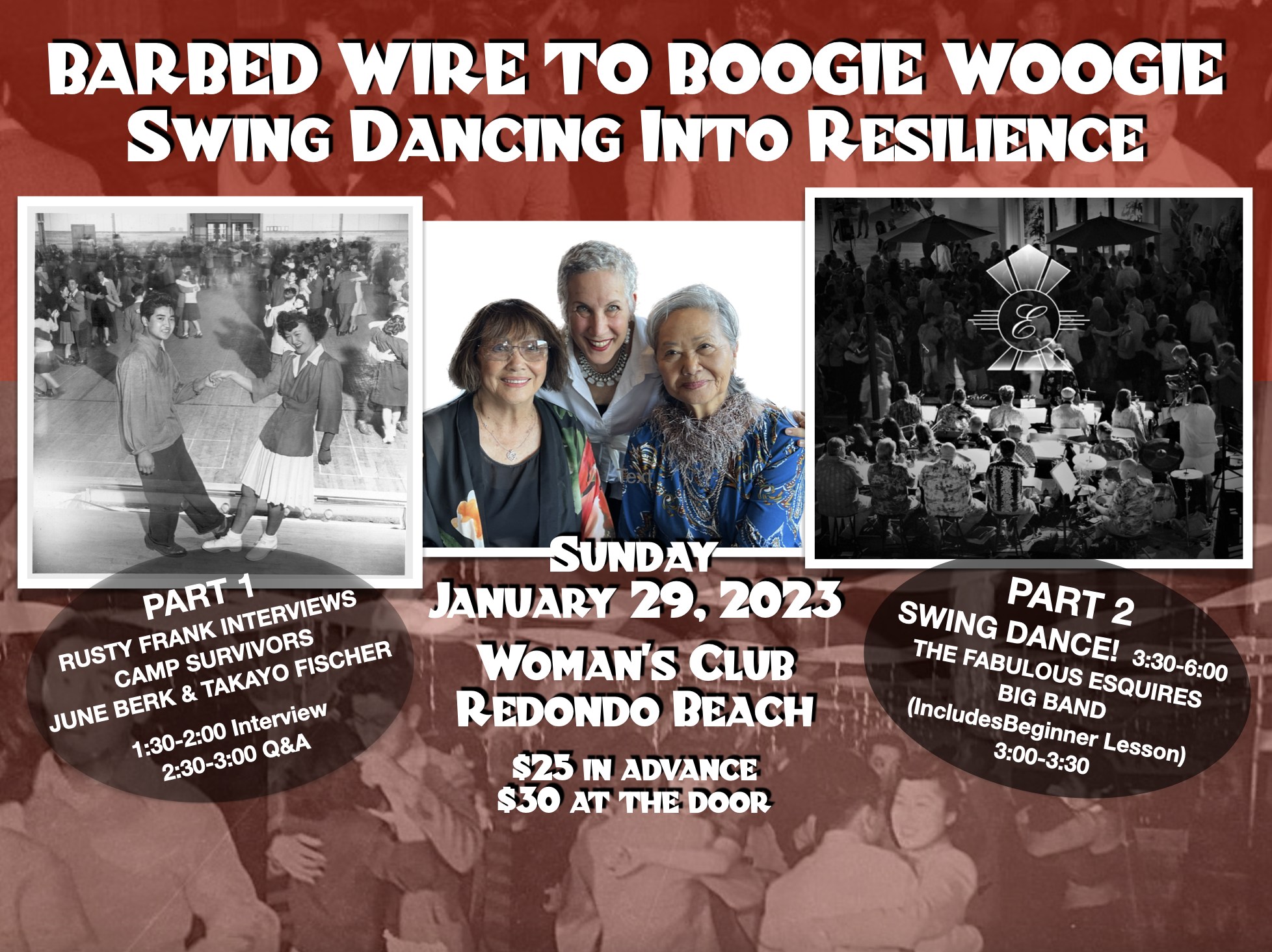
“Barbed Wire To Boogie Woogie”
The Story of Resilience in WWII
America’s Concentration Camps
$25 in Advance
$30 at the Door
Tickets Available through Woman's Club of Redondo Beach:
https://www.redondowoman.org/content.aspx?page_id=4002&club_id=108638&item_id=1859410&event_date_id=255
A TWO-PART EVENT:
PART 1
1:30-2:30
Presentation featuring Camp Survivors
June Aochi Berk & Takayo Tsubouchi Fischer
and Dance Preservationist Rusty Frank
Followed by Q&A
PART 2
3:00-3:00 Beginner Swing Dance Lesson
3:30-6:00 Swing Dance to the Fabulous Esquires Big Band and Swing Dancers
OVERVIEW: Professional dancer and preservationist Rusty Frank takes us on a journey through one of the most troubling times in American history, but through a very different lens of resilience and joy. Her acquaintance with Camp survivors, June Aochi Berk and Takayo Tsubouchi Fischer (who became lifelong friends at age 10 when they were both incarcerated in the Rohwer, Arkansas Concentration Camp during WWII) reveal the story of how parents did everything possible to “normalize” the lives of their children with education, sports, art, culture, AND swing music and dance. The program features a brief history of the Camps, rare photos of Camp dances, a private collection of Camp Dance Cards, as well as an interview with June and Takayo about their personal experiences. The presentation ends with a Q & A.
BACKGROUND: Following the Japanese bombing of Pearl Harbor on December 7, 1941, President Roosevelt signed Executive Order 9066 requiring all persons of Japanese descent living on the American West Coast to be evicted from their homes and sent to live in America’s Concentration Camps (referred to as “Camps” by the survivors).
A total of over 125,000 persons - two-thirds of whom were American citizens - were sent to these prisons around the country. Included in this population were two children, age ten,
June Aochi and Takayo Tsubouchi. Sent off to Rohrer, Arkansas with their families, the two children met and quickly bonded over music, dance, and art.
Like the thousands of children in Camp, these children spent their time from 1942-1945 “having fun,” not realizing until decades later what their parents had done to normalize their lives during these brutal times. By providing the children with an array of sports, dance, art, music, and learning opportunities, the children did, indeed, pass the years without knowing the drama of what had actually happened to them and their families.
It is an astounding fact that every one of the ten Camps had swing bands which played at regular dances. With names such as “The Jive Bombers,” “The Music Makers,” and the “Stardusters,” these bands brought swing music to the young prisoners and played a vital role as therapy, as joy, and as a connection to the outside world.
THE PRESENTATION IS FOLLOWED BY A SWING DANCE!
Come one. Come all. There will be a short beginner's swing dance lesson before the band plays. And there will be plenty of swing dancers there to help all the newbies cut a rug.
Dance Styles
Lindy Hop (100%)
Pricing
Advance:$25.00
At the Door:$30.00
Organizer
R
Rusty Frank
J