About this Event
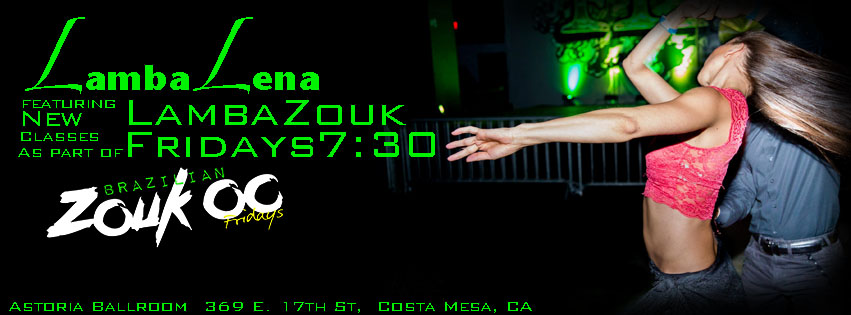
Featuring NEW Lambazouk class as part of our amazing Friday OC Zouk event!!!
7:30 Lambazouk with Lena Thieme, aka LambaLena!!
Come learn the fundamentals through intermediate/advanced lambazouk moves, full of allegria and energia!!!!
Followed by Ruana's intermediate and beginner zouk class
Followed by the BEST zouk social in So-Cal!!!!!!
LambaLena blurb :P
Lena has been part of the LA Zouk community since 2009. She is a classically trained ballet dancer for almost 20 years with a BFA in ballet teaching and performance and also holds a Master's degree in physical therapy. She has recently returned from a 6 month world tour with the Brazilian dance show, "Brazouka", the story of legendary lambazouk dancer, Braz dos Santos. She has learned invaluable information of Lambazouk and traditional zouk styles from this experience as well as from various teachers from Brazil and Argentina. She is really looking forward to sharing this information with everyone so we all can enjoy the feel-good energy of LambaZouk!
FYI, LambaZouk on Wikipedia:
LambaZouk, also called the Porto Seguro-style, is often thought of as the evolution of original Lambada, although in its current iteration it has divulged far from original Lambada. This dance is characterized by high energy (energia) and feel good attitude (alegria). Although it is a fast and energetic dance, it flows smoothly and the moves are continuous and rhythmic, and dancers follow circular (and to a lesser extent slot-style) movements as they relate to each other. One way in which the present LambaZouk differs from the original Kaoma-like Lambada style, is that they have removed wiggling shoulder movements (also sometimes seen in Cuban-style salsa). Instead the shoulders are kept fixed while the hips move (swing) to create a sensual effect. A number of movements have been added to the modern version of this dance mainly created by Didi Santos of Brazil.
LambaZouk is characterized by the following movements:
Head movements (Cabeça - head moves in the same direction as shoulder; Boneca - Head moves in the reverse direction as shoulder for half measure (1-2-3))
(Hair) whip movement (Chicote)
Back arch/dip (Cambre)
The original Porto Seguro style is also unique in the way steps are performed to music (in this sense it is closer to Lambada). Here, the steps are performed with equal emphasis (same amount of travel) on strong beat and the two beats that follow (including the pause after the strong beat). This is done specifically to facilitate musicality by matching sharp movements (Chicote and Cambre) with the strong beat. When danced this way dancers fluently incorporate sharp movements to accentuate strong beat without stopping the dance (pausing to catch up). Even though this timing is popular in LambaZouk it is by no means exclusive. Many LambaZouk dancers also dance by taking longer step (or turning the follower) on the dominant beat (like Traditional Zouk). It is also a common practice to switch between the two timings within the same song (by doing multiple contra-tempo turns for the follower). For comparison on timing, Traditional Zouk emphasizes strong beat by having dancers take a long step on the strong beat. In LambaZouk style (as explained earlier) a popular way is to step equally (length-wise) on strong beat and following two beats. This creates continuous movements.
LambaZouk is danced to rhythmic, up-tempo music (tempo is generally fast or medium, rarely slow), whereas Traditional Zouk is more suitable for slow tempo music (often with long pauses). Kizomba music is very popular in LambaZouk owing to its rhythm and pace. Because the music faster, and head movements are more sophisticated and done more often, dancing LambaZouk requires better technique and timing in order to perform head movements without injuries.
LambaZouk is mainly danced in Porto Seguro, São Paulo, Belo Horizonte, Argentina, Spain, UK, Israel, the west coast of the US, Japan & recently also in Malaysia. LambaZouk is also evolving to include more modern movements. It is also not uncommon (lately) for dancers to switch fluently between these dancing styles during a single Zouk music song.
Dance Styles
Lambada (50%)
Zouk (50%)
Organizer
L