About this Event
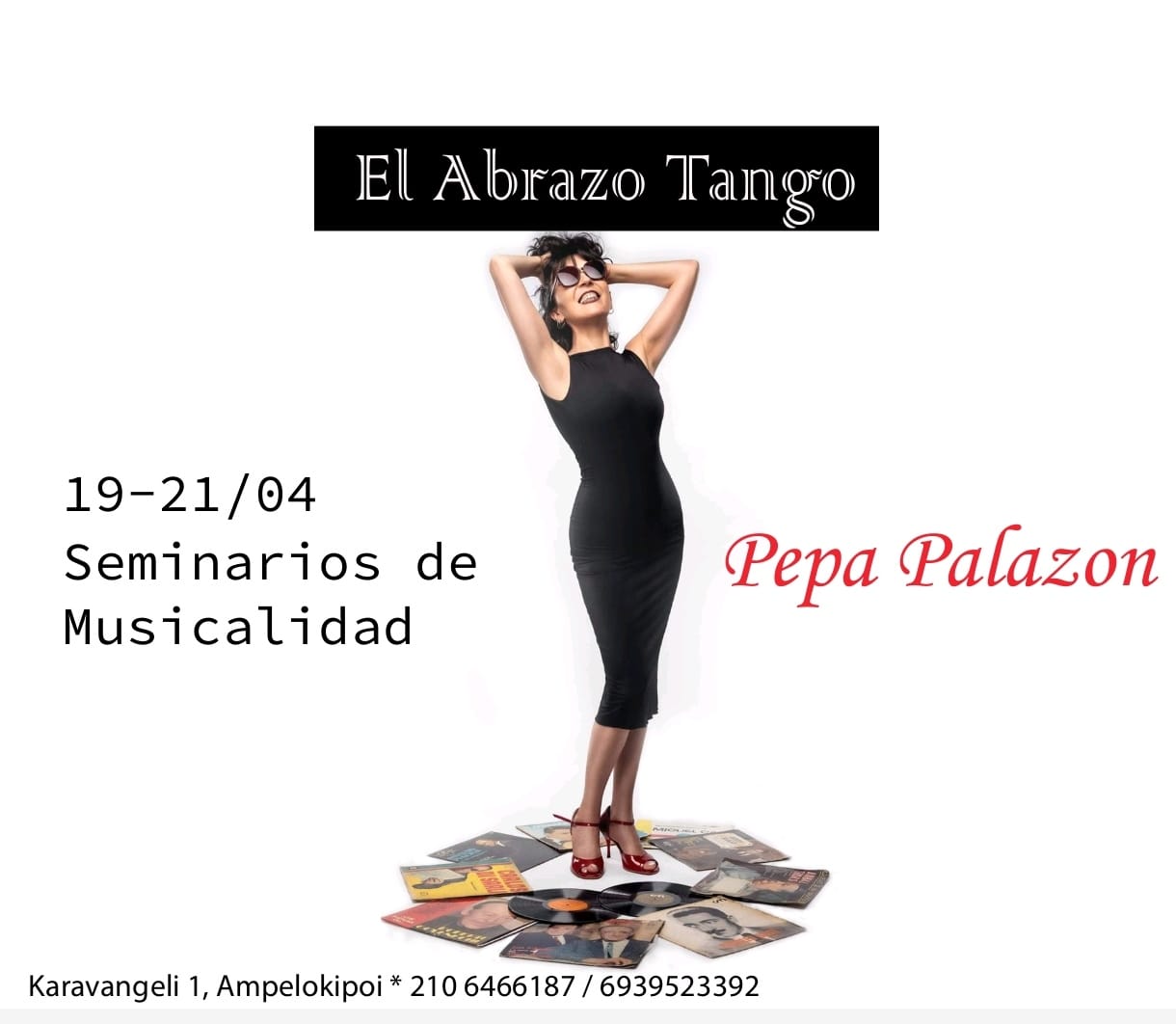
Pepa Palazón στην Ελλάδα !!!
Για πρώτη φορά η Pepa Palazon στη Αθήνα για σεμινάρια μουσικότητας!
Εντατικά και φοβερά σεμινάρια μουσικότητας οργανωμένα με θέματα και ορχήστρες.
Πρόγραμμα μαθημάτων: DANCING THE GREAT ORCHESTRAS
(intensive musicality)
ΠΑΡΑΣΚΕΥΉ:
Class 1 : 19:00-20:30
What do we dance when we dance?
CLASS 1 / CLASE 1 :
RHYTHMIC BASE AND MELODIC LINE IN TRADITIONAL TANGO ORCHESTRAS
-Ritmo y Melodía/ Rhythm and Melody
-Marcato 4 and Marcato 2 (de los bailarines/ of the dancers)
-Pulso / Pulse
- Frase / Phrase.
-Descanso Melódico I / Melodical Rest I
CLASS 2
20:20-22:00 hs
OSVALDO PUGLIESE ORCHESTRA
Arrastre and SINCOPAS
-How to recognize and apply the use of 4 and 1 (in the beat) and Syncopation in dance. Introduction to Osvaldo Pugliese
- Stop Time
●The "drag/ Arrastre" is a very common musical element in some Typical Orchestras, especially in Pugliese, but there are many that use it. Here we begin to get into musical "accents." In this case how the 4 of the measure is accented in a "linked" way and in syncopation.
We will study about the Music of:
Osvaldo PUGLIESE
**No need to come as a couple but is better
--------------------------------------
ΣΆΒΒΑΤΟ
CLASS 3
17:00-18:30 hs
FRANCISCO CANARO
Countermelody and WEEK TIMES
(2 & 4 ) on the Tango Music and Tango Dance
- Contramelodía / Countermelody y
- Week Times I / Tiempos Débiles I
- Descanso Melódico I / Melodical Rest II
●In this class we are going to study Countermelody and Weak Times. The countermelody is a Melody different from the main Melody. And it gives us one more option in the melodic line that enriches the dance. The Weak beats are the 2nd and 4th of the measure. Many times Traditional Orchestras accentuate those two quarter notes instead of the 1 and 3 (downbeats). If we recognize these accent changes we can play with them and dance to them. And that expands our expressive language.
We will study about the Music of:
Francisco CANARO, Rodolfo BIAGI, Osvaldo PUGLIESE and Juan D'ARIENZO
CLASS 4
19:00-20:30
CLASS 4: STOP TIME in the Rhythmic Base.
The importance of the "Pause" in Tango
- Stop Times in the different Tango Orchestras
( Carlos Di SARLI, Miguel CALÓ, Rodolfo BIAGI, and Juan D'ARIENZO)
- How to recognize them and how to dance them. (Rhitmical Structures)
●In this class we are going to studying de StopTime in Tango. The importance of the "Pause" in music and dance. How each orchestra uses that Stop Time differently and how to recognize it and dance to it
We will study about the Music of:
Carlos Di SARLI, Miguel CALÓ, Rodolfo BIAGI, and Juan D'ARIENZO.
--------------------------------------
ΚΥΡΙΑΚΉ
CLASS 5
12:00-13:30
D'ARIENZO ORCHESTRA
- MUSICAL ACCENTS
- and Musical Rest (Musical Bridge)
- The piano in D'Arienzo with Biagi and with Fulvio Salamanca
-The musical Dynamics
-D'Arienzos's Sincopas
CLASS 6
14:00-15:30
ANIBAL TROILO ORCHESTRA
-Rhythmic and Melodic Base in Troilo in his 3 stages
-How to combine them and how to dance them
-332 (in Rhitmic Base)
-Tutti
- Fluctuating Tempo.
19:00-23:00 hs TJ στη milonga EL ABRAZO!!!!!
* Λγα λόγια για την Pepa..
PEPA BIO
** Pepa Palazón, has been organizing one of the most popular milongas in Buenos Aires, Argentina for 12 years: "Viva la Pepa! Milonga". As well, Pepa has been dancing tango for 19 years, and she has been teaching regularly in Buenos Aires and worldwide for 11 years, giving classes for all levels.
She is a graduate of the Superior Conservatory of Buenos Aires music (Tango and Folklore). She specializes in teaching music to dancers.
At the same time, she makes a tv program dedicated to recovering the Living History of Tango Dance, called "Tengo una pregunta para vos" (I have a question for you) that you can watch for free on her youtube channel.
PEPA MUSICALITY CLASSES
His Musicality classes are 100% practical. We work on the verticality of Music, from dance: we study the different musical lines that are heard at the same time in a tango. If you can hear them, you can choose which line to dance and how to dance it.
Separate those lines and teach, with the dance and with concrete musical examples, the main rhythmic and melodic elements that we find in the Traditional Tango Orchestras.
Pepa is a graduate of the Conservatory of Music of Buenos Aires (in Tango and Folklore) and has specialized in musical training for tango dancers for the last 8 years.
PEPA DJ:
Pepa is a graduate of the Conservatory of Music of Buenos Aires (in Tango and Folklore) and has specialized in the musical training of tango dancers for the last 8 years.
As TDj she has played both in Europe and in Argentina. She in Argentina, she in her own milonga (Viva la Pepa Milonga) and in the Main milongas of Buenos Aires such as Villa Malcolm, El Beso, El Tabano, La Firulana or the. Major International Festivals such as Little Women Tanngo Feestival or Lady's Tango Festival
In Europe he has played at International Festivals such as the Oster Tango Festival (Basel, Switzerland) or the HeidelBerg Tango Marathon (Germany) and has provided music at the main milongas in London, Milan, Munich, Madrid, Barcelona, Paris, Verona, Lisbon, Frankfurt, Grenoble etc.
ΤΙΜΕΣ & ΠΑΚΕΤΑ ΜΑΘΗΜΆΤΩΝ:
1 ΜΑΘΗΜΑ = 25 €
2 ΜΑΘΗΜΑΤΑ = 45€
4 ΜΑΘΉΜΑΤΑ= 70€
Super Προσφορά
6 ΜΑΘΉΜΑΤΑ = 85€
Πληροφορίες
6939523392 : Gabriel
6934022668 : Vasia
Dance Styles
Tango (100%)
Pricing
1 class:€25.00
2 classes:€45.00
4 classes:€70.00
6 classes (Super Offer):€85.00
Organizer
G
Gabriel Marino
G
Gabriel Tango Marino
V